Can I Run DeepSeek-V4.1-Flash-1017 Locally? 763B Total, 552B Backbone
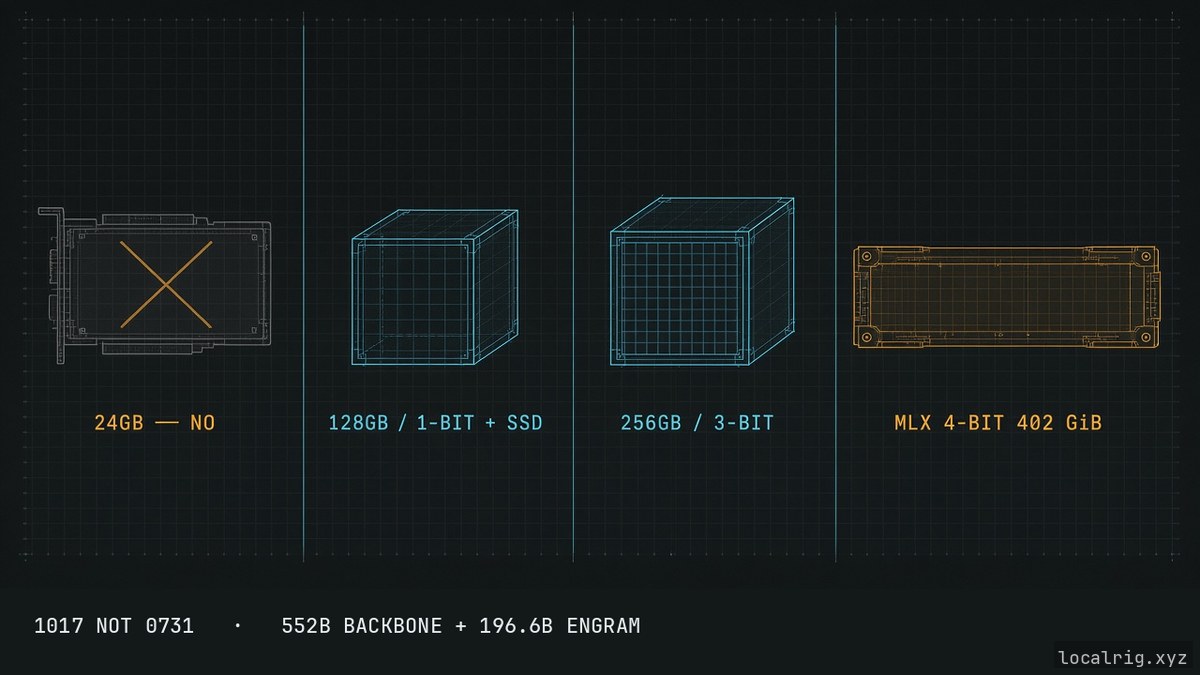
Short answer: Yes, if the box can hold the weights. The 1017 checkpoint is about 763B logical parameters (552B backbone plus 196.6B Engram), not Flash-0731. Unsloth’s 1-bit estimate is 128–145 GB with the Engram table on SSD; 3-bit is 256–290 GB. A 24 GB GPU cannot load it. LocalRig has no tok/s of its own.
This page is only deepseek-ai/DeepSeek-V4.1-Flash-1017, the Hub repo created 2026-10-17. The older 284B-class model stays on Can I run DeepSeek-V4-Flash-0731 locally?. DeepSeek-V4-Pro is the trillion-parameter flagship. Mixing those three names is how a 103 GB shopping list gets pointed at a 230 GB download.
Is DeepSeek-V4.1-Flash-1017 552B or 763B?
About 763.2B logical weights for the full checkpoint. 552B is the language backbone, not the whole file. The 1017 README does not print a parameter total. The split is in the weights.
The official safetensors headers (read 2026-10-21) store two Engram tables:
| Tensor | Dtype | Shape | Logical weights |
|---|---|---|---|
layers.1.engram.embed.weight | F8_E4M3 | 384,006,168 × 256 | 98,305,579,008 |
layers.14.engram.embed.weight | F8_E4M3 | 384,016,682 × 256 | 98,308,270,592 |
| Sum | 196,613,849,600 |
That is 196.614 billion Engram embedding weights. The shapes match config.json (engram_num_embeddings and engram_head_dim 256). Scale tensors sit beside those tables and are not part of this 196.6B product. config.json on the 1017 repo is byte-identical to deepseek-ai/DeepSeek-V4.1-Flash (3,311 bytes, SHA-256 8be45ce0476004a3f529fd896115a4a2e800a129ad2d3ec05b16050f52e21879). 1017 does not resize the network. The README calls it a minor update on reasoning, coding, agent, and vision scores.
The full 763B figure is a weight census, not a sentence on DeepSeek’s README:
- mlx-community/DeepSeek-V4.1-Flash-1017-oQ4e-mtp (created 2026-10-17) lists 763.205B logical weights: language backbone 551.881B, Engram 196.614B, vision encoder 0.485B, MTP head 14.225B. The Engram row matches the official tensor product above.
- Unsloth’s 1017 guide says “552B backbone + 196B Engram.” That sentence does not add the vision encoder or the MTP head. 551.881 + 196.614 = 748.495, which is the pair they rounded.
- Ollama’s
deepseek-v4.1-flash:1017-cloudpage badges the tag 763B and the readme says 552B backbone.
An X news summary (updated 2026-10-20) calls 1017 “the 552B-parameter model.” That is the backbone shorthand. It is the wrong number for the checkpoint you download. The summary’s own disclaimer says it can be wrong.
Ollama’s readme also says 8B parameters are active per token in prefill and 16B in decode. That sentence is not on the 1017 card. The same readme’s score table is the previous V4.1-Flash column (HLE 36.8), not the 1017 column (HLE 42.6). Even if the active count is right for this shared architecture, it does not shrink the file. Six routed experts per token (num_experts_per_tok 6 in config.json) still leaves the other experts on disk.
The Hub index metadata.total_size is 510,286,023,000 bytes (~475.2 GiB). That is stored bytes for the packed FP4/FP8 shards, not a single-GPU VRAM bill and not the 763B count. The official inference/README.md converts those shards and runs them with torchrun at model-parallel 8. That example is a multi-process reference, not a 24 GB recipe.
How much memory does each Unsloth quant need?
1-bit is a 128 GB-class claim with a 128–145 GB band. 3-bit is a 256 GB-class claim with a 256–290 GB band. Copied from Unsloth on 2026-10-21. Their units are RAM + VRAM, or unified memory, with Engram on SSD. “Rest GB” is the minimum they assign to non-Engram weights. The band sits about 5–10 GB above that floor. Context and the runtime can need more. Disk still has to hold the Engram table.
| Quant | Download | Engram on disk | Rest (their floor) | Unsloth memory band |
|---|---|---|---|---|
| UD-IQ1_S | 233.0 GB | IQ4_NL / 110.6 GB | 122.4 GB | 1-bit, 128–145 GB. They name this file for 128 GB RAM. |
| UD-IQ1_M | 250.4 GB | IQ4_NL / 110.6 GB | 139.8 GB | Same 1-bit band. Rest is already 139.8 GB. |
| UD-IQ2_XXS | 300.5 GB | Q5_K / 135.2 GB | 165.3 GB | 2-bit, 176–205 GB |
| UD-Q2_K_XL | 334.8 GB | Q5_K / 135.2 GB | 199.6 GB | 2-bit, 176–205 GB |
| UD-IQ3_XXS | 394.7 GB | Q6_K / 161.3 GB | 233.5 GB | 3-bit, 256–290 GB. They name this file for 256 GB RAM. |
| UD-IQ3_S | 423.6 GB | Q6_K / 161.3 GB | 262.3 GB | 3-bit band, but the floor is already over 256 GB. |
| UD-Q3_K_XL | 485.1 GB | MXFP8 / 202.8 GB | 282.3 GB | 3-bit, 256–290 GB |
| UD-Q4_K_XL | 500.7 GB | MXFP8 / 202.8 GB | 297.9 GB | 4-bit, 305 GB |
| UD-Q8_K_XL | 508.4 GB | MXFP8 / 202.8 GB | 305.6 GB | 8-bit, 315 GB |
Q4 and Q8 land within about 8 GB of each other because Unsloth keeps MXFP4 experts and the same Engram table. “Q4” here is not a 24 GB-card trick. Their top-1 table is a match rate against DeepSeek’s reference (UD-IQ1_M at 88.2% on long17k), not a tok/s table and not a LocalRig quality rank.
Unsloth’s prose is narrower than the band: UD-IQ1_S “will work on 128GB RAM setups” (they list a MacBook, DGX Spark, or RTX Spark), and UD-IQ3_XXS “will work on 256GB RAM setups like a Mac Studio.” A 128 GB machine is the bottom of the 128–145 GB line. UD-IQ3_S’s 262.3 GB floor is a different file from the 256 GB claim.
They also ship a DSpark drafter at Q8_0 8 GB or BF16 8.5 GB, and they say DSpark is about 1.3× to 1.5× on decode. That speedup is their claim. The llama.cpp snippet in the same guide is ordinary decoding, with --load-mode mmap, --lazy-mode on, and the Engram tensor pinned to CPU so the table stays on SSD. Engram and DSpark are different mechanisms.
Official sampling on the 1017 card: temperature 1.0, top_p 1.0, context 1,048,576, max tokens at least 256K. Unsloth’s template defaults reasoning_effort to 75. The interactive example in inference/README.md passes temperature 0.6. Use the card’s table unless you are deliberately following that example. A box that just clears the weight band will not also hold a filled 1M cache. LocalRig has no KV measurement for this architecture. The VRAM calculator is a generic overlay, not an Engram model.
Can a 24 GB, 128 GB, or 256 GB machine run it?
24 GB, no. 128 GB is Unsloth’s 1-bit edge, not a comfortable 3-bit box. 256 GB is the 3-bit class they name, and the top of that band is 290 GB.
A 24 GB RTX 3090 or 4090 is about one-fifth of UD-IQ1_S’s 122.4 GB non-Engram floor. Two 3090s (48 GB) still miss it. This is not a “quantize until it fits” problem. The 1-bit download is already 233 GB because the Engram table is in the file even when it stays on SSD.
If the silicon you have is one 24 GB card, the dense daily driver on LocalRig is Qwen 3.8 27B Q4. A used 3090 is a valid buy for that model. It is not a 1017 buy.
Browse used RTX 3090 24GB on eBay → only when the workload is 27B-class. Do not buy a 3090 expecting 1017 to load.
For the Unsloth 128 GB claim, read DGX Spark 64GB vs 128GB and DGX Spark vs dual RTX 3090 as machine context. Dual 3090 is still 48 GB. It does not become a 128 GB unified pool. LocalRig has no 1017 tok/s on a Spark.
Check Mac Studio 256GB on Amazon →
That search is the 3-bit class Unsloth names. It is not a promise that every 256 GB Mac clears UD-IQ3_S, and it is not a price. M5 Ultra configuration notes are about the machine, not a LocalRig 1017 bench.
If you want the official multi-process path before buying a 256 GB box, rent. RunPod, Vast.ai, and GPUMart GPU hosting are the marketplace options. The card’s MP=8 example is datacenter-shaped: Vultr GPU Cloud lists A100, H100, and L40S, not a consumer 4090. Break-even against buying is rent vs buy.
Does the 402 GiB MLX build fit a 512 GB Mac?
The file size is confirmed. A measured fit on a 512 GB Mac is not. mlx-community/DeepSeek-V4.1-Flash-1017-oQ4e-mtp is an oMLX v0.7.1 oQ4e conversion of this checkpoint, created 2026-10-17. The card’s storage total is 402.363 GiB (432.033 GB), including Engram (114.444 GiB), the backbone (279.520 GiB), vision (0.904 GiB), and the MTP head (7.495 GiB).
402.363 GiB is less than 512 GiB of unified memory. That comparison is arithmetic. The card does not publish a resident peak, a context length, or a tok/s on a 512 GB Mac. macOS does not hand the GPU every byte of a 512 GB machine. LocalRig will not upgrade “smaller than 512 GiB on disk” into “fits and runs.”
Unsloth’s GGUF 4-bit band (305 GB, Engram on SSD, 500.7 GB on disk) is a different file from this MLX build. Do not add those two 4-bit stories into one number.
What speeds have actually been published?
Three named reports, none of them a LocalRig run, and they are not the same machine. Treat each row as community-cited or as the publisher’s own number. Empty cells stay empty.
| Report | Date | Hardware | Model and quant | Runtime | Figure | What is missing |
|---|---|---|---|---|---|---|
| Max Weinbach | 2026-10-19 | 256 GB M5 Ultra Mac Studio | ”Deepseek v4.1 Flash,” 3-bit mixed | Not named | ~35 tok/s decode | Single-source. No 1017 in the text, no context, no runtime version. |
| oMLX 0.7.2 | 2026-10-21 | M3 Ultra 512 GB | 1017 -mtp, oQ3e | oMLX 0.7.2 | Decode with Lightning MTP + CED 49.4 → 68.2 tok/s (+38%). Prefill 700 → 949 tok/s. 16K prompt. | Author’s measurement. Not an M5 Ultra. The release says M5 Ultra 256 GB tests were still to come. |
| ddalcu iQ-MLX 3.0 bpw, v1.0 | card date 2026-10-18 | M5 Ultra 256 GB | 1017, iQ-MLX 3.0 bpw | mlx-serve 26.10.2 plus PR #911 | Serial 69.4 tok/s. DSpark: code 79.6, prose 51.9, agent 100.4. | Project card. Releases through 26.10.2 cannot read this layout without that PR. |
| mlx-serve v26.10.3-pre-release.1 | 2026-10-20 | ”an M5 Ultra” | Quant not named | mlx-serve | ”up to ~150” tok/s, prefill “up to about 1,800” | Project claim. Does not say 1017 versus the September checkpoint. No context, no quant. |
Weinbach’s ~35 and ddalcu’s 69.4 are both “M5 Ultra, 256 GB, roughly 3-bit” only if you ignore the missing runtime on the post and the different quant on the card. Do not average them. oMLX’s 68.2 is a 512 GB M3 Ultra at oQ3e with speculative decoding on, at a 16K prompt. The same release’s oQ4e row on that machine is 53.8 → 64.1 tok/s decode with MTP + CED. Jun Kim’s post the same morning points at that release; the release table is the one with the checkpoint name.
The v26.10.2 notes (published 2026-10-12, five days before the 1017 card) say DeepSeek-V4.1-Flash can run on a 128 GB Mac by streaming experts from SSD, crediting davidtai’s mlx-stream. That sentence predates 1017. The 1017-specific mlx-serve pack says a 256 GB Mac, about 206 GB resident (199 GB with MTP off), a 425 GB download of which 203 GB is Engram read from SSD, and about 215 GB free to load. v26.10.3-pre-release.1’s 128 GB streaming line names GLM-5.3-Flash and MiMo-V2.6-Flash, not 1017.
Is it on Ollama, stock llama.cpp, or mlx-serve?
Ollama’s library listing is cloud-only. Stock llama.cpp had not merged 1017 as of 2026-10-21. mlx-serve’s 1017 pack needs a pull that the 26.10.2 release notes say they cannot read.
Ollama tags checked 2026-10-21: deepseek-v4.1-flash:cloud and deepseek-v4.1-flash:1017-cloud. No third tag. GitHub issue ollama/ollama#19079 was retitled with a “Cloud:” prefix the day the card appeared. ollama run deepseek-v4.1-flash:1017-cloud is a hosted API, not a local GGUF. The 763B badge on that page is a size label for the cloud tag, not a file you pull onto a 24 GB card.
Unsloth’s llama.cpp steps fetch ggml-org/llama.cpp pull 30817 (“model : add DeepSeek-V4.1-Flash (deepseek41)”), opened 2026-10-19. The pull was open and unmerged when checked on 2026-10-21. A release build from before that pull is the wrong binary for their GGUF. The GGUF repo is unsloth/DeepSeek-V4.1-Flash-1017-GGUF, created 2026-10-17.
mlx-serve is a third path, and the 1017 pack card says text only: the vision tower is in the download and the server does not use it yet. Runtime comparison without this SKU pinned is Ollama vs llama.cpp vs vLLM. There is no vLLM memory recipe on the 1017 card beyond the PyTorch MP=8 example.
Does the Arena rank change what hardware you need?
No. Arena WebDev is a hosted vote, not a VRAM table. The open-source filter at arena.ai/leaderboard/code/webdev, table dated Oct 19, 2026, lists DeepSeek-V4.1-Flash-20261017 (Max) at open-source rank 1, overall rank 13, score 1664 ±14, 2,008 votes, MIT, 1M context. The previous row on that board, DeepSeek-V4.1-Flash-20260910 (Max), is rank 8 among the open-source list at 1618.
The X news summary’s 1,670 points and overall #12 do not match that Oct 19 table. An earlier scrape can be true and still be stale. LocalRig is citing the board it loaded on 2026-10-21. The summary’s claim of an Agent Arena rank was not re-checked here and is left out.
The 1017 card’s own quality table is a vendor scorecard. One cell, so the SKUs stay distinct: Terminal-Bench 4.0 42.3 for 1017 versus 31.2 for the previous V4.1-Flash, Claude Code harness, DeepSeek’s protocol. That is not a tok/s, and it is not a reason to ignore the 233 GB download.
Who this is NOT for
- Anyone shopping Flash-0731’s ~103 GB 3-bit file. That page is still right for 0731. It is the wrong download for 1017.
- A 12–24 GB card, including a used 3090 bought for this model. The non-Engram floor Unsloth prints is 122.4 GB. Buy the 3090 for Qwen 3.8 27B, or rent.
- Readers who treat “552B” as the whole model, or “16B active” as the file size. 552B is the backbone. Active experts do not delete the other experts from disk.
- Anyone pasting ~35 tok/s, 68.2 tok/s, 69.4 tok/s, or ~150 tok/s onto a different Mac. Different quants, runtimes, and one of them does not name 1017. All of them are single-publisher or single-post.
- Anyone who wants
ollama runto drop a local 1017 weight. The library tags checked 2026-10-21 are cloud tags. - Shoppers who need a LocalRig first-party tok/s before they trust the file size. There is no
engine.dbrow. The Engram shapes are still on the official shards.
Methodology
- Parameter split: Official
config.jsonand the safetensors headers ofmodel-00047-of-00048andmodel-00048-of-00048, read 2026-10-21. Engram embed product 196,613,849,600. Full-checkpoint 763.205B is the mlx-community oQ4e card’s logical-weight table, whose Engram row matches that product. Unsloth’s “552B + 196B” and Ollama’s 763B badge are the other two public wordings. No number was averaged into a third total. - Fit bands and file sizes: Unsloth’s 1017 guide, accessed 2026-10-21. Vendor estimates. Engram-on-SSD is their serving note, not a LocalRig measurement of RAM after offload.
- MLX 402.363 GiB: mlx-community card, repo created 2026-10-17. Storage only. No resident-fit claim added.
- Speeds: Weinbach’s post (single-source, runtime unnamed), oMLX 0.7.2 release notes (author, M3 Ultra 512 GB, 16K), ddalcu’s pack card (publisher, M5 Ultra 256 GB, mlx-serve plus PR #911), mlx-serve v26.10.3-pre-release.1 (project claim, quant unnamed). The 128 GB SSD line in mlx-serve v26.10.2 is dated 2026-10-12 and is not applied to 1017.
- Arena: open-source WebDev board as rendered 2026-10-21, table stamp Oct 19, 2026. Hosted ranking. Not a local bench.
- Ollama: tag list on 2026-10-21 contained two cloud tags. llama.cpp PR 30817 was open and unmerged the same day.
- LocalRig first-party: none for DeepSeek-V4.1-Flash-1017 as of 2026-10-21.
Sources
- deepseek-ai/DeepSeek-V4.1-Flash-1017 — README,
config.json(byte-identical to the September V4.1-Flash config), safetensors Engram shapes, indextotal_size,inference/README.mdMP=8 example. HubcreatedAt2026-10-17. Accessed 2026-10-21. - Unsloth, DeepSeek-V4.1-Flash local guide — 552B backbone + 196B Engram, quant disk sizes, 128–145 / 256–290 GB bands, DSpark module sizes, llama.cpp PR 30817. Accessed 2026-10-21.
- unsloth/DeepSeek-V4.1-Flash-1017-GGUF — GGUF repo, created 2026-10-17.
- mlx-community/DeepSeek-V4.1-Flash-1017-oQ4e-mtp — 763.205B census and 402.363 GiB storage. Created 2026-10-17.
- Ollama
deepseek-v4.1-flashtags —:cloudand:1017-cloudonly, checked 2026-10-21. 1017-cloud page badges 763B. - Max Weinbach, 2026-10-19 — single-source ~35 tok/s, 3-bit mixed, 256 GB M5 Ultra. Runtime not stated.
- oMLX 0.7.2 and Jun Kim’s post — 1017 oQ builds on an M3 Ultra 512 GB. Published 2026-10-21.
- Arena WebDev, open-source filter — 20261017 (Max) at 1664, open-source rank 1, overall 13. Table dated Oct 19, 2026. Accessed 2026-10-21.
- X news summary — 552B wording and a 1,670 / #12 figure that does not match the Oct 19 board. Updated 2026-10-20.
- mlx-serve v26.10.2 (2026-10-12, pre-1017 128 GB line) and v26.10.3-pre-release.1 (2026-10-20, ~150 tok/s claim, quant unnamed).
- ddalcu/DeepSeek-V4.1-Flash-1017-MLX-Serve-iQ-MLX-3.0bpw — 256 GB Mac, ~206 GB resident, project speeds. Card version date 2026-10-18.
- llama.cpp PR 30817 — open, unmerged, 2026-10-21.
- Can I run DeepSeek-V4-Flash-0731 locally? — the older SKU. Do not reuse its 103 GB table here.
Frequently Asked Questions
Can I run DeepSeek V4.1 Flash locally on a 24 GB GPU?
No. Unsloth's smallest 1017 file, UD-IQ1_S, is a 233.0 GB download. They put the non-Engram floor at 122.4 GB before a 128–145 GB working band. A 24 GB card, or two 24 GB cards, does not hold that. Use Qwen 3.8 27B Q4 on a 3090 instead.
Is DeepSeek-V4.1-Flash-1017 a 552B model or a 763B model?
Both numbers describe different slices. The official Engram tables are 196.6B weights. The mlx-community oQ4e card counts 763.205B logical weights in the full checkpoint, of which the language backbone is 551.881B. Unsloth and Ollama call that backbone 552B. A 552B headline leaves out Engram, the vision encoder, and the MTP head.
Will a 128 GB or 256 GB Mac run DeepSeek V4.1 Flash?
Unsloth says 1-bit UD-IQ1_S works on 128 GB RAM setups, and their requirements table still lists 128–145 GB for 1-bit with Engram on SSD. They say 3-bit UD-IQ3_XXS works on 256 GB setups such as a Mac Studio, inside a 256–290 GB band. LocalRig has not measured either machine.
Does the 402 GiB MLX 4-bit build fit a 512 GB Mac?
mlx-community/DeepSeek-V4.1-Flash-1017-oQ4e-mtp lists 402.363 GiB of tensor storage (432.033 GB), created 2026-10-17. That file is smaller than 512 GiB. The card does not publish a measured resident peak, and macOS does not give the GPU the whole 512 GB. Treat fit as unpublished.
Is DeepSeek-V4.1-Flash-1017 on Ollama as a local download?
Not as a library weight. On 2026-10-21 the tag list had only deepseek-v4.1-flash:cloud and deepseek-v4.1-flash:1017-cloud. Both are cloud tags. A local run is a GGUF or MLX file from another publisher, not ollama run of a library manifest.
How fast is DeepSeek V4.1 Flash on a Mac?
LocalRig has no row. Max Weinbach posted ~35 tok/s decode at 3-bit mixed on a 256 GB M5 Ultra on 2026-10-19, with no runtime and no 1017 in the text. That is single-source. oMLX 0.7.2 measured 1017 oQ3e at 68.2 tok/s with Lightning MTP on an M3 Ultra 512 GB, not an M5. Do not mix those figures.
Is this the same model as DeepSeek-V4-Flash-0731?
No. Flash-0731 is the older ~284B MoE with Unsloth's ~103 GB 3-bit file. 1017 is the 17 Oct 2026 card. Keep the 0731 page for that SKU. Do not reuse its memory table here.